It’s not too surprising that Humanoids from the Deep would prove to be one of the bigger hits of producer Roger Corman’s prolific career. Like Joe Dante’s Piranha (another Corman production released a year earlier in 1979), Humanoids from the Deep contained all the elements that brought kids and young adults to the drive-in and suburban cinemas in droves during those last few glorious years of the grindhouse, before the burgeoning home video market exploded and enabled many of us to indulge our cinematic perversions in the comfort and privacy of our own lounge room.
And paramount among these elements was, of course, the melding of sex and horror, precariously balanced so that the women averted their eyes in terror and revulsion while the male sitting beside them try to desperately hide (or relieve) their hard-ons.
Inspired by The Creature from the Black Lagoon (1954), Jaws (1975) and the aforementioned Piranha, as well as Del Tenny’s fun 1964 romp The Horror of Party Beach, Humanoids from the Deep follows a similar plot device used in many of the ecological horror films of the 1970s. In the small Californian fishing village of Noyo, a conglomerate planning to build a huge canning factory nearby has been experimenting with a growth serum designed to increase the size of the local salmon, but instead succeeds only in creating a school of green, humanoid-like creatures who rise out of the ocean to tear apart the men and (surprise) mate with the women. Naturally, by the time our hero (fisherman Doug McClure) and heroine (scientist Ann Turkel) figure what is going on, it’s too late to stop the creatures from going on a rape and kill rampage during the opening night of the annual village carnival.
While it’s an overall enjoyable romp that hits all the exploitation targets, Humanoids from the Deep unfortunately stops short of being a genuine cult pleasure. Joe Dante’s Piranha worked so well because it combined the director’s genuine love for the genre with John Sayle’s witty screenplay and a roster of actors who bought the characters to life - including Bradford Dillman, Dick Miller, Barbara Steele, Kevin McCarthy and Heather Menzies. In Humanoids from the Deep, the cast seem to be mostly going through the motions, alternately looking bored and confused, with only Vic Morrow as a gruff, booze-swilling fisherman providing any real frisson.
When director Barbara Peeters handed in her finished cut of the film, Executive Producer Corman felt the film was lacking in the required exploitative elements, and had second unit director James Sbardellati beef-up the sex and blood quota, including some explicit shots of the humanoids raping bikini-clad beach gals which left Peeters very unimpressed.
Highlights of Humanoids from the Deep include the creature costumes designed by future make-up/FX superstar Rob Bottin, James Horner’s music score, the sight of young ventriloquist David Strassman getting torn apart just as he (and his dummy) are about to score with a young nubile nude in a tent (this will please those who found Strassman’s frequent appearance on Hey Hey It’s Saturday throughout the 90s to be extremely grating), and an all too brief appearance by bubbly blonde (and criminally underused and underrated) Linda Shayne as the Salmon Queen.
Shout! Factory’s 30th anniversary DVD release of Humanoids from the Deep gives the film the full treatment, including a new anamorphic widescreen transfer of the uncut international version of the film (which bore the simple title of Monster), deleted scenes, making-of featurette, trailers and radio/TV ad spots, a short clip of Leonard Maltin discussing the film with Corman, and a color booklet.
Copyright John Harrison 2011
Sunday, January 2, 2011
HUMANOIDS FROM THE DEEP
Saturday, December 18, 2010
VALE JEAN ROLLIN

http://www.shockingimages.com/rollin/interview.htm
Friday, December 3, 2010
KILLER CRABS Paperback Review
(1978/New English Library/UK)
Often downgraded as the poor man’s James Herbert (The Rats), Guy N. Smith was one of the most pure pulp writers of the 1970s. With no pretence to literary art, Smith authored some of the most visceral, arousing and downright exciting horror novels from that era, all of which were tailor made for the paperback medium.
A published writer from the age of 12 (when he contributed to his local newspaper), Smith had a career in banking forced upon him by his father, before he broke the shackles with his first book Werewolf by Moonlight, published by NEL in 1974. It marked the beginning of an intensely prolific career for Smith, who now has over 60 horror novels to his credit, not to mention a number of crime thrillers (he wrote a serial killer book, The Hangman, under the pseudonym of Gavin Newman), and his 1996 volume Writing Horror Fiction (A&C Black), a how-to manual for aspiring writers wanting to break into the genre.
Killer Crabs was the second and best of Smith’s series of Crabs books (the original, Night of the Crabs, having been published in 1976), and provides a great summation of his prowess as a writer. The premise of the series is one of pure B-grade schlock: an army of giant, ravenous crabs bob up from time to time at various exotic locales around the globe, wreaking havoc and snacking on the locals.
After being driven out of Wales in the first novel, the crabs this time resurface in the sunny far north of Australia, where they settle down to spawn in the mangrove swamps not far from the popular Hayman Island holiday resort. After treating us to an expected opening chapter crab attack (aboard a small fishing trawler), Smith settles in to introduce us to his cast of cliched but delightfully sleazy cast of characters, including Klin, the ruggedly-handsome, G I Joe - type action man, big game hunter Harvey Logan, British scientist Clifford Davenport (returning from the first novel), and holidaying sexpot Caroline du Brunner, who beds everything in sight bar the crabs, and whose sexual adventures Smith details with an enthusiastic gusto that would have doubled the pleasure of any young male who had picked the book up expecting a mere horror story.
‘Klin began to push forward with his thighs, slowly and purposefully at first, then speeding up as his tension mounted. Her eyes were closed. She was breathing heavily, her whole body stiffening, jerking, convulsing inwardly. Her legs shot upwards bicycling, faster and faster, and her fingernails tore viciously at his shoulders and back. Seconds later she was going crazy with passion beneath him, pushing her thighs at him, grinding her pubic bone on his as she sought desperately for an even deeper penetration.’
The scenes of carnage in the book are equally exciting, as the crabs multiply at enormous rate and move inlands towards the resort, a trail of death and destruction littering their wake. Smith revels in describing these scenes with a sadistic glee, bringing forth images of a gaudy, EC-inspired 1950s horror comic, as this passage describing the demise of a Japanese fishing captain amply illustrates:
'The crab was astride the captain, its legs holding him firmly, whilst the pincers, almost delicately, explored his body in search of another limb to amputate.
Helplessly the crew watched, some of them being sick with revulsion. It reminded them of a spider finding a fly caught in its web, and instead of devouring it immediately preferring to torture its victim by ripping off a leg at a time.
The severed wrist still spouted blood, a bright red fountain which sprayed over the crab, rendering it an even more horrific spectacle. Almost effortlessly the pincer found the shoulder joint and with a loud crunch removed the whole arm. Then, seconds later, the captain’s other arm suffered an identical fate.’
With its winning combination of action, gore, sex and never a dull moment plot, it’s surprising that an adaptation of Smith’s crab paperbacks never made it to the cinema (or even the straight-to-video shelf). With the plethora of shoddy Jaws clones that were festering flea pit cinemas during this time (Tintorera, Grizzly, etc.), I would have thought that a film about man-eating crabs would have had every cigar chomping schlock producer foaming at the mouth (I can just see the poster, depicting a horde of the ugly titular creatures emerging from the red-tinged surf, a screaming, bikini-clad young woman clenched between the triumphant claws of the leader crab!).
Copyright John Harrison 2010
Sunday, November 14, 2010
THE KILLING KIND
Directed by one-time experimentalist filmmaker Curtis Harrington, The Killing Kind remains one of the best examples of early-seventies sick sinema. The film borrows its ideas and themes from a number of sources - most notably Psycho - and blends them into a strong psychological thriller that is murky and dark without being relentlessly depressing.
The film opens on a deserted beach, where a group of male youths are enjoying their pack rape of a young tease named Tina (Susan Bernard, the pretty little imp from Faster, Pussycat! Kill! Kill!). Although Terry (John Savage) is an unwilling (and unable) participant in the activities, he is the only one who is charged for the crime, and ends up spending two years in jail. Upon his release, he returns to live with his mother (Terry Southern) in an old, moody boarding house filled with mostly elderly women for tenants.
Almost immediately, we can see that the relationship between Terry and his mother is a little bit off-kilt. He calls her Thelma instead of ‘mom’, they kiss each other on the lips, she fondles his hair playfully, and they indulge in physical wrestling matches. Although Harrington never fully exploits it, there is an obvious sexual tension between mother and son, and the performances by Savage and Southern are terrific, and the chemistry in their scenes together strong and electric.
The Killing Kind is a film filled with ugly, repressed characters. When a frustrated neighbour (the wonderful Luana Anders) visits Terry at night, she tells him “It must feel wonderful….being raped. I wouldn‘t have told on you”. Oddly enough, it’s Terry who emerges as one of the film’s most sympathetic characters - even though he degenerates into a sadistic, psychotic killer, he seems as much an oedipal victim as a brutal monster.
What little humour is present in The Killing Kind is extremely black in tone. Terry and Thelma work themselves into fits of laughter talking about how one of the elderly boarders died after having a seizure and falling into the frozen foods cabinet at the local supermarket. In the words of Thelma: “She became a frozen stiff”. In another surprise sequence, when pretty young Lori (future Laverne & Shirley star Cindy Williams) tells Terry to “Loosen up”, he responds by trying to drown her in the swimming pool!
By the end of the film, we realise that Terry’s time in jail have had little to do with his present state of unbalance. The character he has become is what he was always destined to be, probably since early childhood. His killing of Tina and the female lawyer he holds responsible for putting him behind bars doesn’t purge him of his homicidal rage. It merely opens the floodgates to his true self, and he soon turns his attentions to the innocent Lori.
A film deserving of more praise than it currently receives, The Killing Kind was for years only available on long out-of-print VHS, until finally being released on DVD in 2007 by Dark Sky Films in a nice, uncut anamorphic widescreen print (along with an interview with Harrington recorded not long before his death).

Copyright John Harrison 2010
Saturday, November 13, 2010
MACHETE
In 2007, Robert Rodriguez and Quentin Tarantino, perhaps the ultimate ‘fan boy’ directors of the past 15 years, teamed up for Grindhouse, their valentine to all those gloriously tacky, often violent and always sexy drive-in exploitation double-bills of the 1970s. Unfortunately, the finished film turned out to be little more than an interesting misfire, amusing and enjoyable but one that could have - and should have - been so much more.
But one clear highlight of Grindhouse (in its original cinematic format) were the fake trailers shown at the beginning of the film and in-between the two features (Planet Terror and Death Proof). In particular, the faux trailers for Eli Roth’s sick slasher Thanksgiving and Rodriguez’s revenge actioner Machete garnered great audience reaction and were singled out as being worthy of expansion into features.
While we’re still waiting for Roth to come through, Rodriguez (along with co-director Ethan Maniquis) has answered the call by turning his two-minute long Machete trailer into a 104 minute ballet of outrageous and highly stylised comic book violence. Low on plot, high on splatter, tongue planet firmly in cheek.
Machete (Danny Trejo) is a former Mexican Federale, now an illegal immigrant doing day labour jobs on the streets of Texas after he is left for dead (and his wife is killed) by slimy drug lord Torrez (Steven Seagal, pilling on the pounds and sporting an hilarious toupee). Reluctantly, Machete accepts an offer from spin doctor Benz (Jeff Fahey) to assassinate McLaughlin (Robert De Niro) a corrupt Senator. The expectant double-cross sees Machete on the run, hacking his way through the bad guys with everything from weed whackers to surgical instruments and seeking help from a sultry taco slinger and leader of a rebel group (Michelle Rodriguez), his Padre brother (Cheech Marin), and the sexy immigration agent Sartana (Jessica Alba, who has the distinction of being both the film‘s worst actor and it‘s best-named character). Also along for the ride are Don Johnson as a trigger-happy border vigilante, make-up effects maestro Tom Savini as a hitman and Lindsay Lohan, who seems to have every one of her vices and exploits etched on her 24 year-old face and spends most of her scenes drugged-out or naked, before donning a nun’s habit and going postal (in what is either a smirk at Lohan’s public persona or just a simple nod to Zoe Tamerlis’ character in Abel Ferrara’s 1981 classic Ms. 45).
Naturally, this being a homage to low-grade seventies sinema, the film has a washed-out look, with deliberate scratches and jumps, retro fonts on the opening credits and some funky porn music on its soundtrack (not to mention a pretty silly nod to the famous bionic sound effect used in The Six Million Dollar Man). But while Rodriguez clearly has a genuine affection for the cinema that inspired Machete, and it shows his commitment in that he went ahead with the film even after the box-office failure of Grindhouse, there is still something disappointingly fake about the movie. Perhaps it’s all the blatant CGI violence, so over-the-top at times that it actually becomes quite tiresome. Or maybe it’s because these films weren’t made to be shown in suburban multiplexes filled with bratty designer-clothed kids and the latest Harry Potter epic playing next door. They were made to be watched as the bottom feature on an all-niter at the suburban drive-in, or in grotty, musty shoebox cinemas that have stained screens and play hardcore porn films every other day.
Maybe it’s because you just can’t make ‘em the way you used to, no matter how sincere you might be.
Still, if you can deal with the film’s forced hipness, Machete, anchored by the presence and raw charisma of 66 year-old Trejo in his first starring role, offers up enough visceral thrills to make a passable time-filler, best enjoyed with a couple of friends and a few cold beers. But it’s no substitute for the real thing.
Copyright John Harrison 2010
Saturday, October 16, 2010
A TEENAGER IN BABYLON
by John Harrison
St. Kilda in 1981.
Twenty-nine years ago.
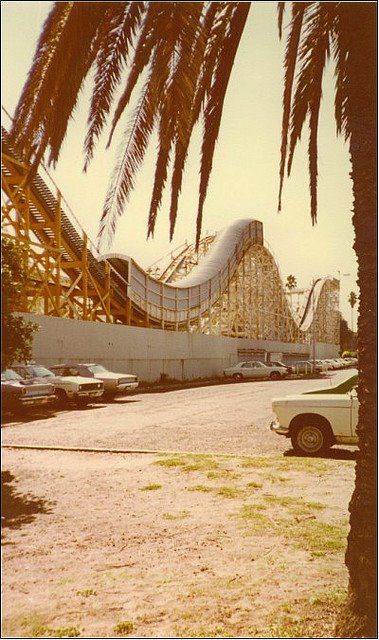
If I close my eyes and try hard enough, I can often still smell that distinct, peculiar odour of rotting carpet, dirty ice and teenage sweat that would fill the dank, cavernous expanse of the St. Moritz ice skating rink which sat on the rim of the Upper Esplanade, overlooking Port Phillip Bay, the majestic art deco arch of the Palais Theatre and the iconic, gaping big-mouth entrance to Luna Park. St. Moritz had first opened its doors in 1921, and had been the place where my parents had met many, many midnights earlier, but by 1981 the building - just like much of St. Kilda itself - was in a state of decay and disrepair, and was only a few months away from closing its grand doors for good (after which it would stand deserted until gutted by fire three years later, it‘s charred innards coldly hauled away by Whelan the Wrecker).
St. Moritz became one of the hubs of my rapidly expanding universe in those days. Ice skating was my elective ‘sport’ of choice while I was a student at the Christian Brothers College in East St. Kilda, and every Wednesday after lunch period a group of us would take the chaperoned walk down Dandenong Road and onto Fitzroy Street, my small group of friends and I (school misfits, all) lagging behind so we could share a stolen cigarette and drink in all the lurid sights the area had to offer back then, the drab, dirty greyness and rustic brick of the landscape providing a suitable milieu for the diversity of people who inhabited it - the drunkards whose better days were decades behind them, musicians and new wave hipsters doing their best to look elegantly wasted and fashionably streetwise, the sickly junkies either looking in desperation for their next hit or stumbling around in the midst of it, the prostitutes who took us in with wary eyes as they chain-smoked and looked for trade, and the collection of other unique characters and desperados who wandered aimlessly and seemed to be doing nothing but killing time and waiting anxiously for darkness to fall. At the time, St. Kilda was still looked upon as a dirty and dangerous place, full of intrigue, crime, sleaze, sex and corruption, and Fitzroy Street was seen as the beating heart that pumped out all of this vice to the surrounding areas, a continual parade of buzzing neon, greasy hamburger joints (where it was always rumoured you could order a hit of smack with your Chicko Roll), badly-lit amusement arcades, seamy sex shops, skid row apartments, grotty milk bars, and the odd backroom gambling den.
The highlight of our walk would invariably be the sight of our horrified chaperone frantically waving us past the George Hotel, ordering us to avert our eyes lest they be tainted forever. At the time, the George had attained notoriety as one of the seedier hotels in the St. Kilda area (no mean feat, indeed). Built in between world wars, by the 1960s it had become a respite and watering hole for hookers and local lowlifes, and in 1970 played host to Melbourne’s first drag shows. The entrance to the George, loudly advertising their striptease shows and burlesque dancers - This Is The Show! - was a work of garish art that should be proudly on display in a museum someplace.
As 3:30 rolled around I would start the short walk from St. Moritz to the relatively straight and secure confines of my weatherboard Elwood home. Usually I would stop by the Acland St. McDonalds (formerly the site of a great wax museum), hoping I’d be served by the cute girl with the blonde sharpie hairdo (short and spiky on top, wispy rat tails at the back) and silver lightning bolt earrings, the glittering outline of her homemade AC/DC shirt clearly visible through her uniform. She was probably no more than a year or two older than me, but already seemed light years out of my fumbling league. I’d sit at a table with my fries and shake and watch the parade of shady characters as they wandered in and out of the notorious Esquire Motel, scene of many drug overdoses and even a gangland killing before it was renovated and re-opened as an Easystay, providing a clean and safe environment for guests and maids you can trust, but robbing the place of its ambience and sense of sordid history.
On the days it was open, my nights back then were almost always spent haunting Luna Park. How cool it was to have such an attraction a mere ten minute walk from your front door. Many locals may have taken it for granted, and some no doubt thought the place was behind the times and ready to be bulldozed, but that was one of the reasons why I was drawn to it so strongly and so consistently. Walking the outskirts of that archaic, wooden white frame and entering that creepy, gaping clown’s mouth, it was like stepping back in time, to an era of rattling, death trap rollercoasters, dodgem cars that showered a continual rainbow of electric sparks over your head, a ghost train whose scariest feature was the occasional derelict slumped in the corner cradling a half-empty bottle of cheap red, and huge bundles of wispy, sickly sweet pink fairy floss that had you running around on a sugar high for the next week. It was a slice of Coney Island in my own back yard, and how could you not love the names of those rides and attractions? The Big Dipper, the Rotor, the Whip, the River Caves, the Giggle Palace with its psychotic laughing clown looking down at you from his throne. All that was missing was the row of sideshow tents featuring tattooed women and two-headed fish boys. It was a magical and beautifully gaudy electric wonderland, one whose exterior still looks very much the same today, though the interior will break the heart of anyone who remembers and loves the place for what it once was.
After leaving high school at the end of 1981, I spent the remainder of the decade riding the coattails of all the things that made living in St. Kilda at the time so exhilarating for me. They were simple but grand days: My years behind the counter of St. Kilda Video, on the corner of Acland and Barkly Streets (now the Big Mouth Café), where the customers often provided more drama, humour and horror than any of the movies we rented out. Long drinking and bullshit sessions at the Doultan Bar, when it was still just a dim, smoke-filled little cubicle frequented by the same tiny group of regulars and the odd blow-in. Devouring slices of Tony’s pizza - randomly cut in odd, almost Picasso-esque shapes - while marvelling at the huge collection of postcards from around the world that lined the wall of his Acland St restaurant (Tony would eventually die doing what he loved doing, keeling over at his pizza oven in front of horrified and hungry customers). All night dope-fuelled marathons popping coins into the latest games at the Red Cave Amusement Arcade, just down from the Greyhound Hotel. Dancing with drag queens at Bojangles and spilling out from the cramped confines of the Linden Tree and onto Fitzroy St just in time to see the dawn break. Feeling the visual and aural assault of the Bad Seeds, Screamin’ Jay Hawkins, Wall of Voodoo, the Huxton Creepers and others from the centre of the Venue’s sticky, beer stained floor.
Copyright 2010 John Harrison
Sunday, September 26, 2010
BACHELOR PAD #12
COLLECTABLES TRADER

UPDATE
Russ Meyer's Finders Keepers,Lovers Weepers/Pandora Peaks
http://dvdholocaust.com/review.php?id=556
42nd Street Pete's Night of Perverted Pleasures
http://dvdholocaust.com/review.php?id=565
Sunday, June 13, 2010
ANIMAL KINGDOM
Australia/2010/Directed by David Michod

Friday, June 4, 2010
LITTLE SHOPPE OF HORRORS Nos. 23/24

Issue 23 covers two of my favourite, somewhat lesser known, Hammer Horrors from the mid 1960s, The Reptile (1965) and The Plague of the Zombies (1966), including interviews with Reptile star Jacqueline Pearce, the late great character actor Michael Ripper, and a rather incendiary interview with the director of both films, John Gilling, who has some very strong and not so flattering things to say about most of the people he worked with at Hammer (and kudos to Klemensen for running the interview as is, in what is mostly a Hammer friendly and positive magazine). Other features in this issue include an interview with Michael Gough (Konga, Hammer’s Phantom of the Opera, Horrors of the Black Museum), Michael Carreras on 10 Seconds to Hell and more.

The current issue of LSOH (24) is devoted to the Mummy movies produced by Hammer (The Mummy, The Curse of the Mummy’s Tomb, The Mummy’s Shroud and Blood from the Mummy’s Tomb), and with its plethora of rare pics and detailed production information, is a must-have for any fans of the series, including an interview with the stunning female star of Terrance Fisher’s sumptuous The Mummy, Yvonne Furneaux.
If you love Hammer Films, or admire vintage British horror cinema in general, you’d be doing yourself a big disservice if you don’t pick up this publication. Apart from all the in-depth interviews and information it contains, the magazine is also beautifully designed, printed on quality glossy paper, profusely illustrated with often rare photos, and features some gorgeous cover and interior art by the likes of Bruce Timm, Mike Schneider and Mark Maddox.
www.littleshoppeofhorrors.com

Thursday, May 27, 2010
PORTABLE GRINDHOUSE
PORTABLE GRINDHOUSE:
THE LOST ART OF THE VHS BOX
by Jacques Boyreau
(Fantagraphics Books/USA/2009/200 Pages)
Review Copyright John Harrison 2010
GRINDHOUSE: SEX, DRUGS & ROCK ‘N’ ROLL
Director: Various
Cast: John Ashley, Andrew Prine, Arch Hall, Jnr., Johnny Carrol
Studio: Umbrella Entertainment
Aspect Ratio: 2:3 Widescreen and 2:3 Full Frame
Region: NTSC All
Running Time: 514 Mins
No. Discs: 4
The latest in Umbrella’s line of ‘Grindhouse’ releases (following on from their Ted V Mikels and Retro Sexploitation sets) is comprised of releases put out by cult film critic/musician/writer/wrestler Johnny Legend on his own Legend House label in the US, and focuses primarily on vintage juvenile delinquency (or JD) cinema from the 1950s and early-60s, with a few oddities thrown in for good measure.
ROCK BABY, ROCK IT (1957/B&W)
Directed by J. G. Tiger
A grimy obscurity filmed in Dallas, Rock Baby, Rock It tells the predictable tale of a teen dance club being shut down and taken over by rock & roll hating gangsters. Filled with clichéd jive dialogue (“Play it cool, Kitten”) and featuring mostly local actors with some very un-Hollywood like faces, this film does have its own strange, low-rent charm, and is filled with some great little-known rock & roll and rockabilly gems from the likes of Johnny Carroll (who also stars), Don Coats & the Bon-Aires, Preacher Smith & the Deacons and The Cell Block Seven.
Directed by O’Dale Ireland
Minor teen idol John Ashley stars as a rich, spoiled bully who rigs the election to become school president and proceeds to intimidate the students and bleed them dry, all the while keeping a dopey accountant and team of leather-jacketed hoods forming a shield around him at all times. It all leads to the usual tragic consequences and eventual comeuppance. A moderately entertaining but fairly staid and unexciting late-period JD film, highlighted by a rollicking theme song belted out by Reggie Perkins (“He’s the gangster in our school…He’s cool, he’s like a freezer…That’s why we call him, High School Caesar”). Ashley went on to appear in beach party movies in the 1960s, then reached an exploitation career high by producing and starring in a string of sleazy Filipino horror films directed by Eddie Romero (including the classic Mad Doctor of Blood Island).
Directed by John Bushelman
Directed by Albert J. Cohen
Directed by Nicholas Merriwether
Directed by Gerald Cormier
The real odd one out in this set, Barn of the Naked Dead wallows in an atmosphere of grimy backwoods sleaze, as three aspiring, Vegas-bound showgirls are kidnapped by a tight-jeaned young maniac (a creepy and effective Andrew Prine) and held captive (along with other women) in his barn, where they are whipped and forced to perform circus tricks (!). Those who don’t comply get doused in blood and chased down by the madman’s hungry cougar. A ludicrous subplot has the psycho’s radiation-scarred father wandering the desert killing people. Although not reliant on nudity or overt lesbianism, Barn of the Naked Dead is nonetheless an interesting and unique riff on the WIP (Women In Prison) films which enjoyed a brief run of popularity in the early 1970s. The creepy electronic score (by Tommy Vig) is offset by the inclusion of a cheesy lounge-like pop vocal (Evil Eyes performed by Pamela Miller).
Friday, May 21, 2010
BETTY PAGINATED #31
Standout pieces from the latest issue include an in-depth review of Mark Hartley's brilliant Ozploitation documentary Not Quite Hollywood (written by fellow zinester Kami), a (justified) rant against comic books artists stealing other peoples' work (including Nick 'son of Gene' Simmons), interviews with veteran Aussie film stuntman Grant Page (Mad Max, The Man from Hong Kong), and Watchmen artist Dave Gibbons, wild 80s pro-wrestler Chris Colt, and much more within it's 36 pages (not to mention all the freebie comics, zines and other goodies Dann usually throws in).
Check it out!
www.bettypaginated.blogspot.com